
You are a Philosopher
....so invest like one

[For best visualization, read on the website here]
“At this point, I will show you something about the nature of education and ignorance.”
This is how Plato begins The Allegory of the Cave, from his epic work of classical philosophy, The Republic, written around 375 BCE.
And that is the way we are beginning today’s post, in which I will prove to you, Dear Reader, that you too are a philosopher.
Let’s descend into Plato’s cave and see what we find.
It’s dark until we come to a fire, which illuminates a wall of the cave. In front of the wall, there are men shackled in place. They cannot move or turn their heads to see what’s behind them. Their figures create shadows on the wall.
There are men behind the prisoners, moving to and fro, holding cutouts of simple stick figures - humans and animals - that also cast shadows on the wall.
One of them is dressed differently from the others. He is much older, has a majestic white beard, and is wearing a flowing white robe.
Is it Plato himself?
“Rejoice, my son!” the philosopher says. “I am Plato. I will personally accompany you on your tour of my allegorical cave.”
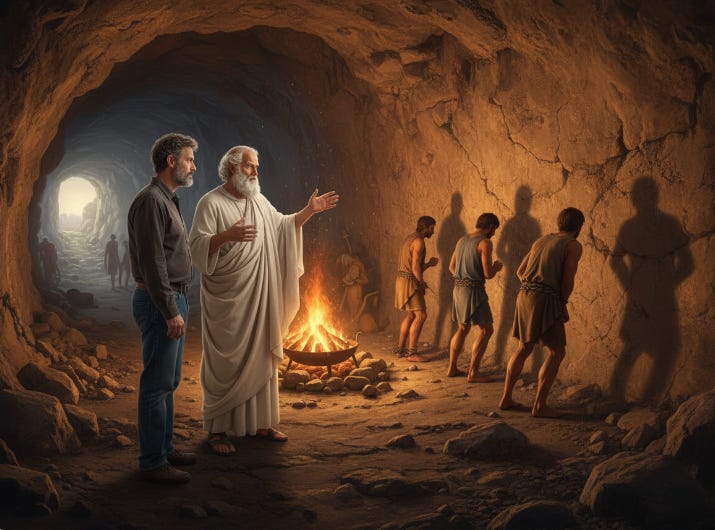
He points to the prisoners, “They are like ourselves - do they see anything except their own shadows?”
You start to wonder what the hell you are doing in a Greek cave 2,500 years ago, but you decide to play along for a bit, and answer Plato’s question with a simple “No.”
“These prisoners think that the truth is nothing but the shadows cast by the cutouts, do they not?”
Plato has a point, and your interest is piqued. After all, you do want to know the truth.
“Now imagine what would happen if some of the prisoners were released from their shackles and suddenly forced to stand up, turn their necks around, and walk to the entrance of the cave. Because of the bright glare, they would be unable to see anything at all.”
Plato continues,
“Let’s say, my son, that you then drag one of these men up a steep hill into the direct sunlight. Would he not feel pain and discomfort? Would he be able to see even one thing that is considered “true” reality?”
“No, not immediately,” you answer.
“You are right!” the philosopher booms. You beam, proud that you are catching on to the logic of Plato’s fable and proving yourself a good student.
“First, our former prisoner will see only shadows in the true world, and will keep his eyes averted from the sun. Then, he will see reflections of people and things in the water. Only after much time will he become used to the light and be able to see the objects themselves.”
“How could it be otherwise?” you ask, startled that you have unconsciously adopted the phraseology of an ancient Athenian.
“Gradually, the freed prisoners will be able to see the sun, and not mere reflections of it in the water. Finally, they will be able to look directly at the sun itself and see it as it is! They will conclude that it is the sun that is responsible for the four seasons and the passing of the year, and it governs all that exists in the visible world.”
Plato puts his arm around your back and says,
“Let’s take a walk together into the city. We are going to converse in the Agora. It is a public square designed just for that.”
Under a well-shaded colonnaded walkway, you sit down with the wise old man.
“First, let me fetch two oinos for us to drink, now that we have come to the most important part of the Allegory.”
He is back in a minute with two clay cups with beautiful designs on their surface, and hands you one of them. You clink cups with him and take a sip. It is a sweet wine that is just divine.
Any reluctance you initially had has disappeared. You are now delighted that you are both pondering and partying with a Greek superstar.
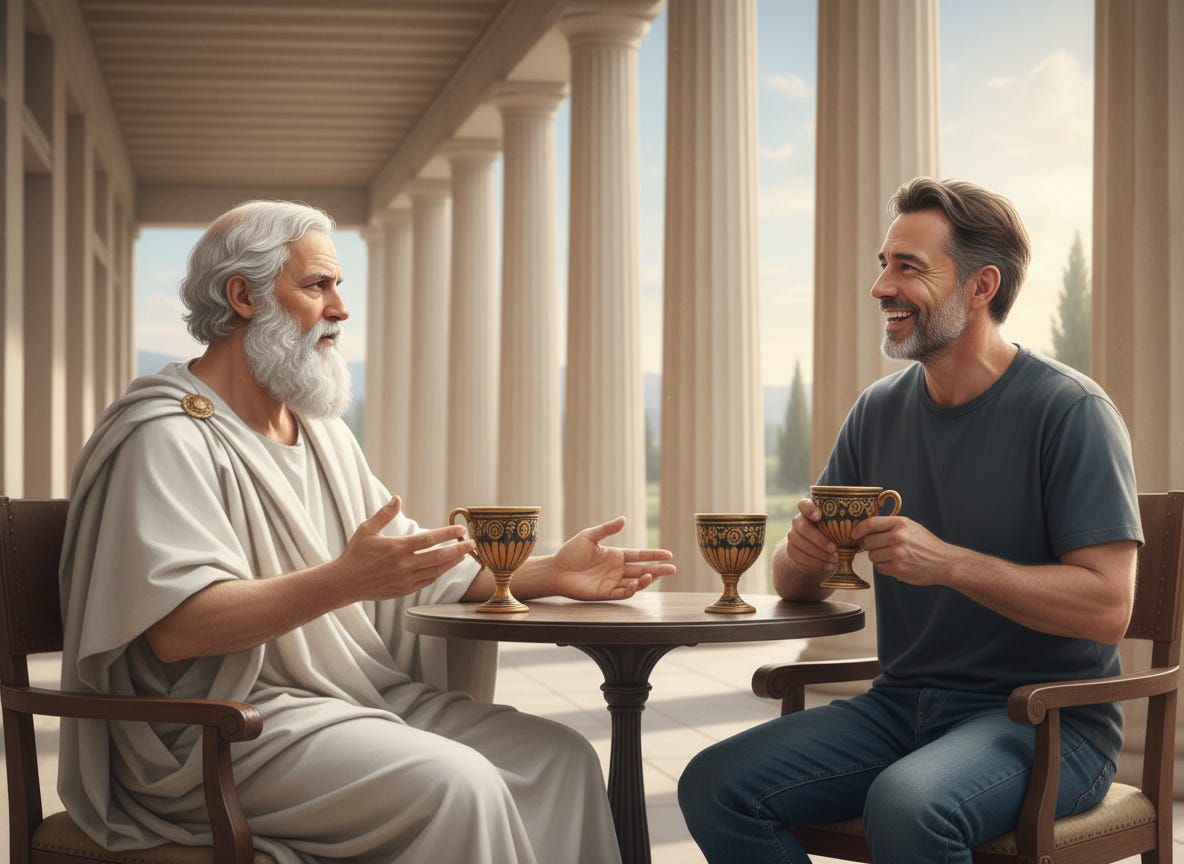
Plato continues recounting The Allegory of the Cave,
“Now, my son, pay close attention and apply this entire imaginary picture to our previous discussion. The prisoners and the shadows represent the visible world. The visible world includes everything we can see, hear, smell, or touch: people, animals, trees, mountains, buildings, shadows, reflections, objects, and even the stars and sun. The fire in the cave that casts the shadows is a symbol of the sun.
The journey upward out of the cave and into the true sunshine is the ascent of the soul into the intelligible world. The intelligible world is the non-physical, eternal, unchanging realm of perfect forms. These forms can be grasped by the mind through reason, philosophy, and dialectic, but not by the senses.”
With that, Plato suddenly rises to his feet and extends his hand for you to shake. You gulp down the rest of your wine, shake his hand, and in the blink of an eye, you are back in 2026, reading this post from the wolf of wall street.
___________________________________________________________________________
The Allegory of the Cave is directly applicable to trading and investing. You probably have already inferred the parallels. The visible world is made up of financial influencers, fake gurus, noise on social media, sensationalist headlines, and the blah-blah-blah from CNBC talking heads. The visible world also includes the blinking numbers and prices on the four monitors we spend too much time staring and screaming at.
The visible world is the world of short-term trading, a pursuit that for almost every one of us is a losing proposition. Unless you are the rare exception (and a lucky few do exist), you won’t take money home when you compete against sharks of Wall Street.
Plato makes fun of the ignorant prisoners who spend their time “predicting how the shadows will move in the future based on their past observations.” Sound familiar? Sounds like rudimentary technical analysis! Except for the very few, drawing lines on a chart without an understanding of the macro world is largely futile.
The intelligible world is the world of longer-term investing. Asset allocation exists in this intelligible world. Diversification, position sizing, and risk management are the Platonic forms that allow us to preserve and multiply our wealth.
The ascent out of the cave of market consensus is arduous. The truth is elusive, and the sun burns our eyes before we reach the intelligible world. There are rarely investment ideas that come from mere reflections in the water. I admit that even after almost forty years in the financial markets, my own ascent is not complete.
At the beginning of this post, I said I would prove you were a philosopher.
The word “philosophy” is derived from two Greek words:
“philo,” meaning “love,” and
“sophia,” meaning “wisdom.”
A philosopher is therefore a lover of wisdom.
Today, you relived the Allegory of the Cave with Plato himself. You listened to and learned from the wisdom of his ancient words. That makes you a lover of wisdom.
And therefore, Dear Reader, you are a philosopher.
Q.E.D.
Thanks for reading the wolf of wall street. Leave a like if you can.
God bless!
Historical note: In The Republic, Plato’s teacher Socrates is the protagonist who narrates the allegory of the Cave. Historians assume that most of the writing and thinking belonged to Plato himself. For simplicity, I have not introduced Socrates in this text, although Plato’s questioning style is an example of the Socratic method.
To Plato ! 🍻