
The Market Will Hit You Back
Lessons from Tudor Jones and a Manchester bloodbath

[For the best experience, read on the website here.]
The Boxing Metaphor
If you are not listening to two or three podcasts a week, you are falling behind everyone else in the market.
But which podcasts are worthwhile?
Unfortunately, there is no easy rule - in my case, my YouTube feed works well.
Proof is this gem of an interview with legendary macro hedge fund manager Paul Tudor Jones that I came across last week.
Although lesser known than George Soros and Stanley Druckenmiller, Tudor Jones is just as much a legend. He began his career as a cotton futures trader and gave himself the nickname “Peanut” because he was small fry on the trading floor. He was fired early in his career for falling asleep on the job after a night of partying in New Orleans.
Today, he is worth between $5 billion and $8 billion.
He positioned himself short for Black Monday, the 1987 crash, when the Dow Jones fell 22.6%. Word around Wall Street then was that it had been a $100 million payday. For the full year, his fund returned 125.9% after fees.
Speaking of fees, the Tudor Investment Corporation charges 4% management fee and 23% of profits. That is the power of Peanut Jones.
Metaphors are a way for the brain to learn new things by anchoring them to something it already knows. When asked to describe the “nature of trading” in the podcast, Jones says:
“A couple of metaphors come to mind. Well, let’s start with boxing because you have an opponent. In this case, it’s the market. You're going into the ring with this opponent, who is after you the whole time.
“And I am thinking more of a classic one as opposed to a Mike Tyson one. But you are parrying, jabbing, feeling each other out, looking for an opening.
“And then every now and then you have a great opening, and you take a big shot, and you may land one.”
“You have these incredible opportunities at times if you just sit and wait the whole time in the interim…you are gathering information looking for these openings. You are always trying to win the round, but there will be those few opportunities where you can do something really material.”
Even if you are not a boxing fan, you undoubtedly often use boxing expressions in everyday conversation. Don’t believe me? Let me attempt to extend Jones’ market metaphor with boxing metaphors that have fortunately become part of the English language:
“The first trading rule is don’t get knocked out. If you find yourself on the ropes and you don’t want to go down for the count, throw in the towel. If you corner your opponent, consider giving him a one-two punch, because he is likely to counterpunch, perhaps below the belt.
If you try to punch above your weight, remember to bob and weave and roll with the punches. Most importantly, stay in fighting shape. That is the best way to go the distance. Don’t count on getting saved by the bell.
See what I mean?
Peanut’s Trading Principles
But back to Peanut Jones. In non-metaphorical language, these are among his trading principles
If I have positions going against me, I get right out; if they are going for me, I keep them. Risk control is the most important thing in trading.
First of all, never play macho man with the market. Second, never overtrade.
Trading is very competitive, and you have to be able to handle getting your butt kicked.
You learn more from your losses than from your gains.
Markets trend only about 15% of the time; the rest of the time, they move sideways.
Sometimes failure is merely chasing you off the wrong road and onto the right one.
You adapt, evolve, compete, or die.
Such are the parallels between trading and boxing: Jones’ rules would benefit a boxer as much as a trader!
Fight of the Century
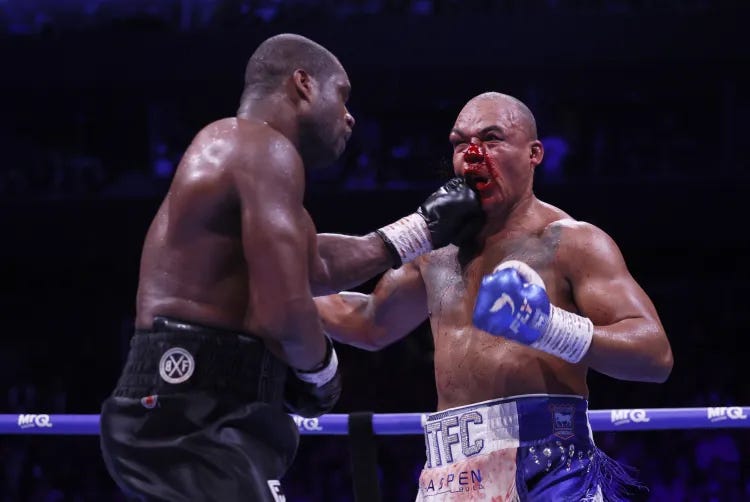
As it happens, this past Saturday, two Englishmen demonstrated those very principles - not in a trading room, but in a boxing ring. Daniel Dubois and Fabio Wardley boxed for the World Boxing Organization (WBO) heavyweight championship of the world.
It will be remembered as one of the most exciting boxing matches in modern boxing history.
Although he was knocked down in the first and third rounds, Dubois took control of the fight and won by technical knockout (TKO) in the eleventh round. From the sixth round on, Dubois landed overhand right after overhand right, flattening Wardley’s nose, swelling his right eye, and otherwise leaving his face a bloody mess.
Dubois followed Tudor Jones’ trading recipe perfectly. He learned from his early-round mistakes and instead of going for a knockout right away, chipped away at his opponent by winning rounds in the middle part of the fight. In the sixth round, he saw his opening and put the overhand right to work.
Like Jones on Black Monday, he recognized that the market was falling fast. He added to his position.
In the eleventh, he really let his hands go and remained the champ.
What about Wardley?
For the boxing metaphor to work within an analysis of Wardley’s fight, remember that a technical knockout occurs when the referee judges that one boxer cannot continue fighting. A knockout occurs when a fighter cannot get up off the canvas after a ten-second count.
Wardley emerged from the battle with a face that may require plastic surgery, but he avoided being knocked out and certainly hasn’t been knocked out of the sport permanently.
I believe he has the heart of a champion and will be back in the ring.
Fabio Wardley, Daniel Dubois, Paul Tudor Jones, you, me - we all have to be able to handle getting our butts kicked.
If you enjoyed this mix of market wisdom and boxing blood, hit the like button, share it with a trader friend, or leave a comment with your favorite boxing metaphor, in English or in Portuguese.
Thks David! PTJ is a legend!