
Superficial Intelligence
Chapter 1: Washington, We Have a Problem

[For best visualization, read on the website here]
A Confession
I confess that the title refers, in part, to my own shallow understanding of Artificial Intelligence. To counter this superficiality, I put in dozens of hours over the past two weeks to deepen my knowledge. The experience has been absolutely head-spinning.
I discovered that this is the most difficult subject to write concisely and elegantly about since I began this newsletter four years ago. But why not go for it? Three chapters.
Since this is a financial newsletter, this first chapter will focus on macroeconomics, policy, and the markets.
The question before us:
What effect will the supercharged AI jump in productivity have on the job market?
The Luddite Fallacy
In early-nineteenth-century England, the “Luddites” formed a movement that protested the introduction of automated machinery in the textile industry. They became saboteurs, raiding their employer’s factories and destroying their machinery.
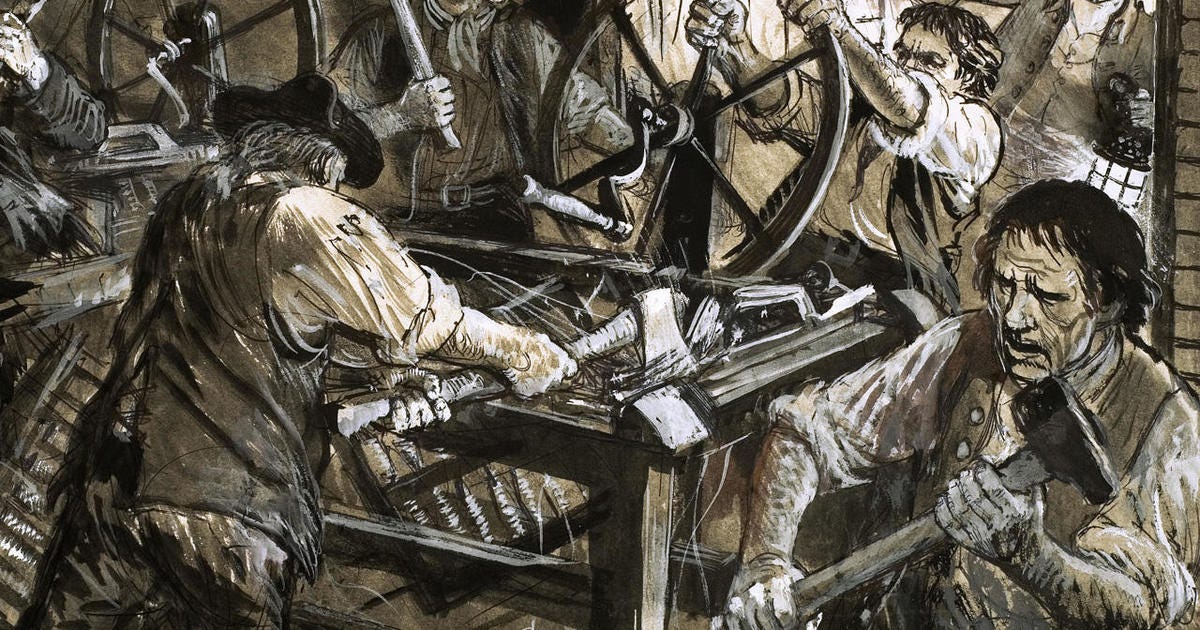
Although the “Luddite Revolution” was mostly concerned with workers’ rights, pay, and dignity, the movement became associated with the belief that technological innovation results in crippling job losses. In the 20th century, economists rejected this notion and coined the term “The Luddite Fallacy.”
The “Luddite Fallacy” meant the opposite: technology did not reduce employment; rather, it improved productivity, which increased societal wealth, and thereby resulted in higher employment.
The Cost of Curiosity
Fast forward two hundred years to a recent interview with the soon-to-be Chairman of the Federal Reserve, Kevin Warsh. Keep in mind, the Fed is the institution charged with maintaining “maximum employment”, so Warsh’s opinion on this subject matters almost more than anyone else’s in the United States
Please watch these 18 seconds:
If you didn’t or couldn’t watch, this is the transcription of the 18 seconds:
“If we have learned anything in economics, what we have learned is that productivity gains are the predecessor to wage gains.
This [AI] is the most productivity enhancing wave of our lifetimes.
The way I think about it is the cost of curiosity is now zero.”
Is the cost of curiosity zero, as Warsh maintains? In other words, is the cost of mass AI adoption really zero?
Now we are getting closer to the head-spinning part.
Artificial General Intelligence
Dario Amodei, CEO of the AI giant Anthropic, wrote an essay last month entitled “The Adolescence of Technology.” Anthropic, OpenAI, and Google DeepMind are the corporations upon which our future depends. They are in a race not only to advance AI’s ability to perform complex human-like tasks (“Agentic AI”) but also to create “Artificial General Intelligence” (AGI) — a system capable of understanding, learning, and performing virtually any intellectual task as well as or better than a human.
For the rest of the post, I will use “AI” and “AGI” interchangeably.
Dario is among the most optimistic players in the AI race. He believes AI could deliver up to 20% growth in GDP. He also believes that AGI may be three years or less away.
This makes his warnings even more credible.
Washington, We Have a Problem
In the introduction to his essay, Dario addresses the sensation my studies gave me - the Emperor has no clothes.
These are Dario’s words:
“I think it would be absurd to shrug and say, “Nothing to worry about here!” But, faced with rapid AI progress, that seems to be the view of many US policymakers, some of whom deny the existence of any AI risks…Humanity needs to wake up.”
Dario lists four existential threats posed by AI:
Autonomy risks. The possibility that a super-intelligent AGI becomes malicious and turns against humanity (Think The Terminator).
Misuse for destruction. A rogue human actor taking control of AGI and using it to destroy humanity (Think Dr. Strangelove).
Misuse for seizing power. The very plausible scenario in which a country uses AGI to dominate its rivals (Think China).
Economic disruption. (Think mass unemployment).
Dario meets Kevin
Let’s imagine Kevin and Dario in the same room, chatting about the future of AI in America.
Kevin might ask, glibly,
“Dario, have you thought about innovations like automated textile machinery, the cotton gin, electricity, oil, the automobile, the ATM, the internet, the smartphone? In each of these cases, productivity soared and higher employment followed.
Dario cringes, but has the poise to respond politely and patiently,
“Kevin, there are two differences: first, AI’s impact on society is occurring over a much shorter period of time than the innovations you mentioned. That means both the public and private sectors have less time to adapt.
“Second, AGI doesn’t affect one or even two sectors of the economy. It affects ALL sectors of the economy. So we have a universal change happening suddenly. We are moving into no man’s land.”
Warsh smiles condescendingly and says,
“Listen, Dario. It’s an incredibly exciting opportunity, and it’s one where, if the US plays its cards right, we will end up with a stronger workforce. That prosperity we’ll have in economics will find its way into national security, so the rest of the world can look at the US again as a shining city on the hill.”
Dario sighs and tries again,
“Kevin, do you really believe it when you say that the ‘cost of curiosity’ is zero? Before you answer, let me tell you something. I predict that AI could displace half of all entry-level white-collar jobs in the next 1–5 years. Of course, I could be wrong. The labor market may be resilient enough to adapt to even such an enormous disruption. But even if it can eventually adapt… the short-term shock will be unprecedented in size.”
The Intelligence Curse
Dario is wound up by now and continues,
“Have you read the white paper, ‘The Intelligence Curse'? I referred to it in the essay I wrote last month. Let me share some of its key points.
“The paper’s core argument is that a productivity shock of the magnitude of AGI will result in white-collar jobs being lost gradually, and then suddenly.”
Dario takes his iPhone from his pocket and says,
“Look at the stages of AI domination of a business:
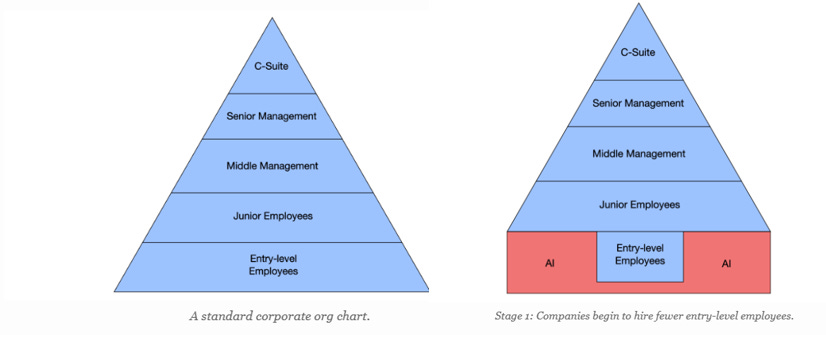
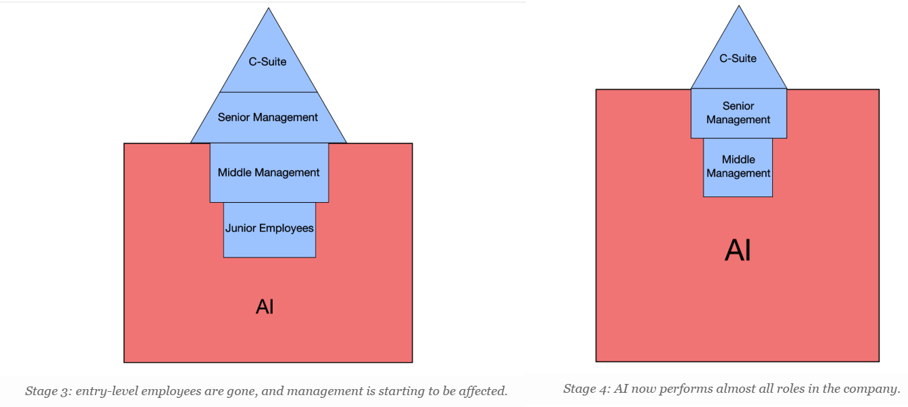
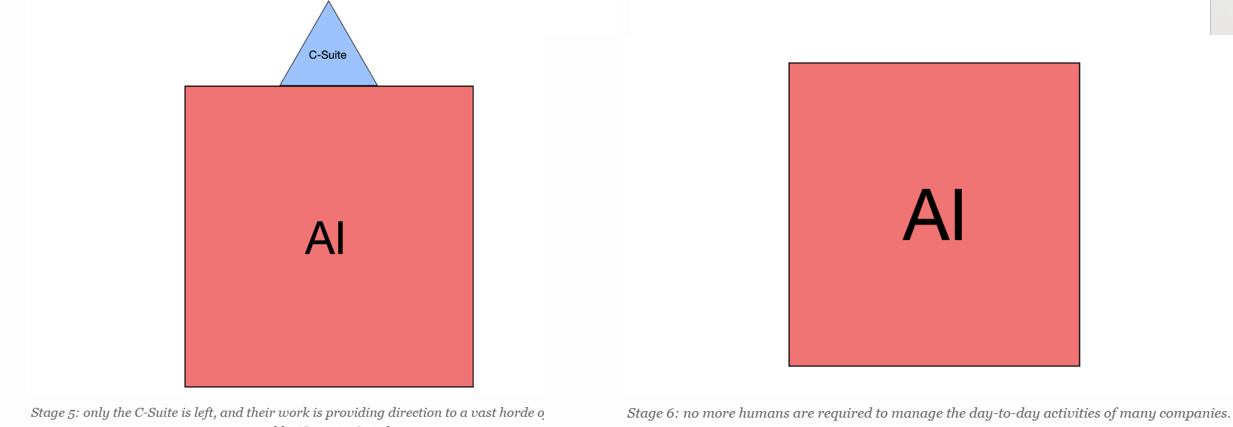
Warsh attended Harvard. He was the youngest member ever of the Fed. He worked with the legendary investor Stanley Druckenmiller. He is nobody’s fool. He has heard this “AI will consume all white-collar jobs” vision before, but he allows Dario to ramble on,
“The driving force behind these diagrams is this: the productivity we will acquire will make white-collar work unnecessary. AGI will do anything a human can do intellectually, but better. We will still need plumbers, painters, and the like, but the shareholders of each American company will insist that management adopt AGI. The supply of labor increases as demand decreases.
“Let me quote from the study:
‘First, if AI results in a massive increase in labor supply, capital could become more of a constraint than labor. The returns to additional labor—machine or human—go down while those to capital go up. This means lower wages and higher returns to capital.’”
“Kevin, think Bernie, think AOC!”
Warsh is a good listener. Dario continues,
“If, and I repeat, if, because we can have no certainty, the thesis of the Intelligence Curse is correct, then the government will have a social crisis of epic proportions on its hands. Around 60% of the workforce is white-collar. Even if only half of the corporate pyramid is replaced by AI, who will care for the displaced masses?
“Kevin, when you say “the cost of curiosity is zero,” - isn’t the possibility of a disastrous outcome dangerous enough to warrant some insurance?
When you buy your dream house, you don’t want it blown apart by a hurricane. So what do you do? You buy insurance. That is the cost of maintaining your dream house.
“AGI is our dream house. But if the government doesn’t invest in insurance, all of AGI’s many benefits may go to waste. To pretend that isn’t true is the road to ruin.”
At that point, Dario lowers his voice and moves closer to the next Chairman of the Federal Reserve.
“Listen, Kevin, mass unemployment is such a terrible outcome that even a Republican government would be forced to implement the socialist dream of “Universal Basic Income.”
“Kevin, think AOC! think Bernie! That should be scary enough for you and the President to be more proactive. The Federal Government has no regulatory framework for AI. The market, the people, our children - we need it.”
Kevin nods his head and reflects on how he can responsibly temper his AI optimism without losing his new job. He certainly won’t mention the AOC part to the President.
The First, but not Final, Showdown
Kevin thanks Dario for his insight, shakes his hand, and leaves the room. Dario looks at his watch. It’s time for him to stop by the Department of Defense to discuss. Anthropic’s $200 million contract with the government. Secretary Hegseth is pissed because he wants to use Anthropic’s cutting-edge technology without any restrictions.
Dario doesn’t want the DoD to use Anthropic technology for autonomous weapons or for spying on American citizens. The rumor Dario heard is that his technology was used autonomously in the raid that snatched Venezuelan strongman Nicholas Maduro. He is pissed, too.
Dario thinks to himself,
“Hegseth is another high-ranking government leader who is seemingly blind to the threats that AI poses to America’s well-being. The government’s understanding of AGI is, well, superficial.”
(Note: This imaginary conversation is based on reality. All of the quotes and ideas are sourced or paraphrased from Dario’s essay, Warsh’s interview, the paper “The Intelligence Curse,” and news reports recounting the DoD/Anthropic disagreement.
The Markets
Now for the part you all have been waiting for.
Markets generally prefer that the government stay out of the private sector’s business. President Trump was elected with the promise to deregulate the economy and unleash the animal spirits. Wall Street has ratified his approach; the S&P is about 20% higher than it was the day before the election.
The question is: will markets demand that the government lay down guardrails to protect us from bad AI outcomes, like the unemployment scenario discussed today?
Markets vote with their feet. 2026 is only seven weeks old. In that short time, we have seen software sector giants crumble in the shadow of AI disruption fears: Microsoft, -18%. Adobe, -26%, Intuit, -43%, Oracle, -28%.
Related industries have also taken a hit: tax return preparer H&R Block, -22%, travel platform Expedia, -33%. And the list goes on.
Also, since the start of the year, McDonald’s shares have rallied 22%. It looks like the market is rotating from the Mag 7 to the Mac 7.
There is a new kid in town. His name is A-G-I, and the new investor game is figuring out whom he will bully and whom he will befriend.
You and I may have only superficial intelligence, but what we do have, let’s use to figure out how to construct anti-AI-disruption portfolios.
More on that tough cookie of a question next week, and the week after.
If you have been inspired by today’s post, please leave a like or, even better, a comment. Feedback is the lifeblood of improvement.
To do that, please go to the website here.
A Final Confession
Sunday evening, the research house Citrini “scooped” me. They took the scenario described in this post - AGI creating mass unemployment - and wrote a detailed futuristic narrative of how markets, politicians, and the Fed would react.
The post is one of the most interesting I have read about the markets in a long time. Here is another confession, one that gives me pleasure to make: their post is even better than this one!
Please read it:


Regards,
David (wolf)
Gostei muito da narrativa, parabéns!